ERP Accounting Implementation Cost & Timeline in the USA (2026)
As the world of small and medium-sized businesses gradually adopts digital transformation, Enterprise Resource Planning (ERP) systems become indispensable in enhancing the efficiency of operations, providing visibility of business finance, and improving scalability in the long run. While basic bookkeeping software may be sufficient at the early stages of a company’s growth, fast-growing businesses can benefit from a more integrated software solution connecting the systems of accounting, finance, inventory, procurement, payroll, reporting, and other business operations.
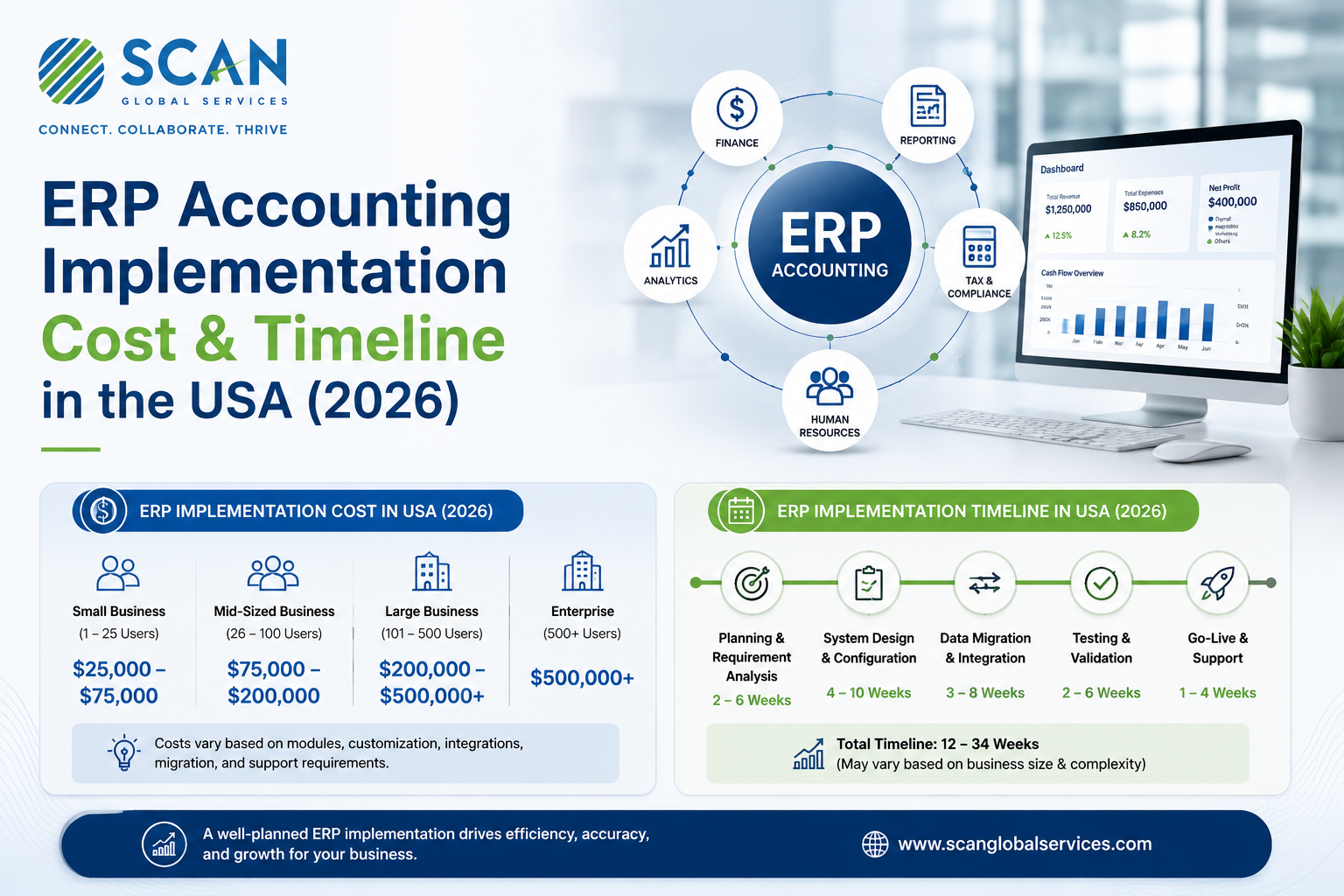
Before the implementation stage, one of the first questions a business owner would pose is, “What will be the cost and duration of ERP implementation?” Unfortunately, the answer may vary according to aspects like the size and complexity of a business, number of users, customization, and implementation assistance. Understanding these aspects helps the management for realistic budget estimation and time planning.
Various organizations across the world now choose to partner with companies providing ERP accounting implementation services in the USA, thus ensuring proper implementation which is less disruptive and allows for an efficient return on investment for ERPs. In this post, we explain how much money SMBs might be expected to spend and the usual implementation time frames, specifying several factors that affect both costs and timeframes.
Why More SMBs Are Investing in ERP Accounting Systems
For growing companies, financial operations run through disconnected software and manual operations have become increasingly challenging. Having multiple systems in use causes duplicate data entry, inconsistency of reports, delays in receiving financial information, etc.
An ERP accounting system brings together key financial functions into a single platform, including:
- General ledger management
- Accounts payable
- Accounts receivable
- Payroll integration
- Financial reporting
- Budgeting and forecasting
- Inventory accounting
- Procurement management
- Fixed asset tracking
- Compliance reporting
By centralizing financial information, ERP systems help businesses improve accuracy, automate repetitive processes, and gain real-time visibility into business performance.
What Determines ERP Implementation Costs?
There is no single cost that applies to every ERP implementation because every business has different operational requirements.
Several factors influence implementation costs, including:
Business Size
Smaller businesses generally require fewer users, simpler workflows, and less customization, resulting in lower implementation costs.
Larger organizations with multiple departments, locations, or legal entities often require more extensive configuration and integration.
Software Selection
Different ERP platforms offer varying pricing structures depending on functionality, deployment model, and licensing requirements.
Cloud-based ERP solutions generally involve subscription-based pricing, while some enterprise systems may require additional licensing and implementation investments.
Customization Requirements
Many businesses require workflows, dashboards, approval processes, financial reports, or integrations that are unique to their operations.
The greater the level of customization, the more implementation effort is required.
Data Migration
Migrating financial information from existing accounting systems into a new ERP platform requires careful planning.
Historical financial records, customer data, supplier information, payroll records, inventory data, and transaction histories must all be validated before migration.
More complex migrations typically require additional implementation time.
Employee Training
Even the most advanced ERP solution will not deliver value unless employees know how to use it effectively.
Training sessions, documentation, and post-implementation support are important components of every successful ERP deployment.
What Do SMBs Typically Pay?
While implementation costs vary significantly depending on business requirements and the ERP platform selected, SMBs should think about the overall project rather than simply the software subscription.
A typical ERP implementation budget may include:
- Software licensing or subscriptions
- Implementation consulting
- System configuration
- Data migration
- Customization
- Integration with existing applications
- Employee training
- Ongoing support
Businesses with relatively straightforward accounting requirements may complete implementation with a modest investment, while organizations requiring extensive customization, multiple integrations, and advanced reporting should expect a higher overall project cost.
The most successful implementations are those where businesses budget not only for deployment but also for optimization and user adoption after the system goes live.
How Long Does ERP Accounting Implementation Take?
Implementation timelines depend on the complexity of the project rather than simply the size of the business.
Most ERP accounting projects follow several structured phases.
Planning and Requirements Analysis
The implementation team begins by understanding the organization’s accounting processes, reporting requirements, approval workflows, compliance obligations, and operational objectives.
This stage establishes the foundation for the entire project.
System Configuration
The ERP platform is configured to reflect the organization’s financial structure, user roles, chart of accounts, reporting hierarchy, and approval processes.
Additional integrations may also be developed during this phase.
Data Migration
Financial information from legacy systems is cleaned, validated, and transferred into the new ERP environment.
Testing ensures that balances, transactions, and reports remain accurate after migration.
User Testing and Training
Employees participate in system testing while receiving practical training that prepares them for daily operations after implementation.
This phase allows businesses to identify and resolve any issues before the system becomes fully operational.
Go-Live and Ongoing Support
After the completion of the testing phase, the ERP system becomes the primary accounting system of the company. The implementation partners usually provide the necessary post-launch support to answer the questions, maximize the efficiency of business processes, and facilitate the transition process. In accordance with the specifics of any particular project, the implementation process takes from a few weeks for implementation of a simple project to several months for a heavily customized ERP solution.
Common Challenges During ERP Implementation
ERP implementation is a significant business initiative, and organizations should prepare for potential challenges.
Common issues include:
- Incomplete project planning
- Poor data quality
- Unrealistic implementation timelines
- Limited employee training
- Resistance to change
- Insufficient testing
- Weak communication between stakeholders
Working with experienced implementation specialists helps businesses anticipate these challenges and establish processes that reduce project risks.
A structured implementation methodology often results in smoother deployment and stronger long-term system performance.
Why Professional ERP Implementation Support Matters
An ERP system is far more than a software installation. It is a transformation of the organization’s financial processes.
Professional implementation partners help businesses:
- Define project objectives
- Configure accounting workflows
- Manage data migration
- Develop reporting structures
- Integrate existing business systems
- Train employees
- Support post-launch optimisation
Their experience reduces implementation risks while helping businesses achieve faster returns on their ERP investment.
Without expert guidance, businesses may experience delays, unnecessary costs, and underutilised system capabilities.
How scanglobalservices Supports ERP Accounting Implementation
scanglobalservices provides integrated accounting, bookkeeping, payroll management, audit assistance, financial controller services, CFO advisory, and ERP accounting implementation support designed to help businesses modernize their financial operations.
With over 70 years of experience in the field and a cutting-edge approach to delivery across the globe, Scan Global Services collaborates with its clients to understand their specific accounting needs, facilitate financial processes, and ensure that their ERP projects are successful.
The company’s team of professionals can assist clients with financial mapping, software installation, support with migration, reporting optimization, and financial management.
Thus, the company has a unique combination of technical skill and excellent knowledge of accounting procedures, which enables it to create an ERP system that works optimally.
By combining technical expertise with deep accounting knowledge, scanglobalservices helps businesses implement ERP solutions that improve efficiency, reporting accuracy, and long-term scalability.
Need help with financial reporting? Talk to Our Experts
Final Thoughts
The implementation of an ERP accounting system has the potential to revolutionize the technology landscape of a growing business. The costs involved and the timeframes required for the implementation of an ERP system depend on the complexity level of the project; proper planning, realistic budgeting, and hiring experienced professionals to assist in the implementation process of the ERP system can positively affect the outcome.
A company must assess the total value of the implementation of the ERP system; rather than focusing only on the costs of the software purchase, companies should consider the benefits of enhanced transparency of finance, efficiency-oriented operations, automated processes, improved reporting, and sound decision-making.
Organizations that look for ERP accounting implementation services in USA can decrease the uncertainty associated with the implementation process, minimize risks of implementation, and make sure that the ERP system becomes an essential element of the long-term operations of the organization by collaborating with a reliable ERP services provider.
Frequently Asked Questions
What factors affect ERP accounting implementation costs?
Implementation costs depend on business size, software selection, customization requirements, data migration complexity, system integrations, employee training, and ongoing support needs.
How long does ERP accounting implementation usually take?
Timelines vary according to project complexity. Simpler implementations may take several weeks, while larger and more customized projects can take several months from planning through post-launch support.
Why do SMBs invest in ERP accounting systems?
SMBs invest in ERP systems to automate financial processes, improve reporting accuracy, centralize business data, strengthen compliance, and support long-term business growth.
Why is professional ERP implementation support important?
Experienced implementation partners help businesses configure systems correctly, migrate data securely, train employees, minimise project risks, and ensure the ERP platform supports operational objectives.
How does scanglobalservices support ERP accounting implementation?
Scanglobalservices offers assistance with implementation of ERP accounting, accounting, bookkeeping, payroll management, audit support and other financial services to modernize the financial operations of the companies through organized implementation of the required processes and long experienced specialists in accounting.