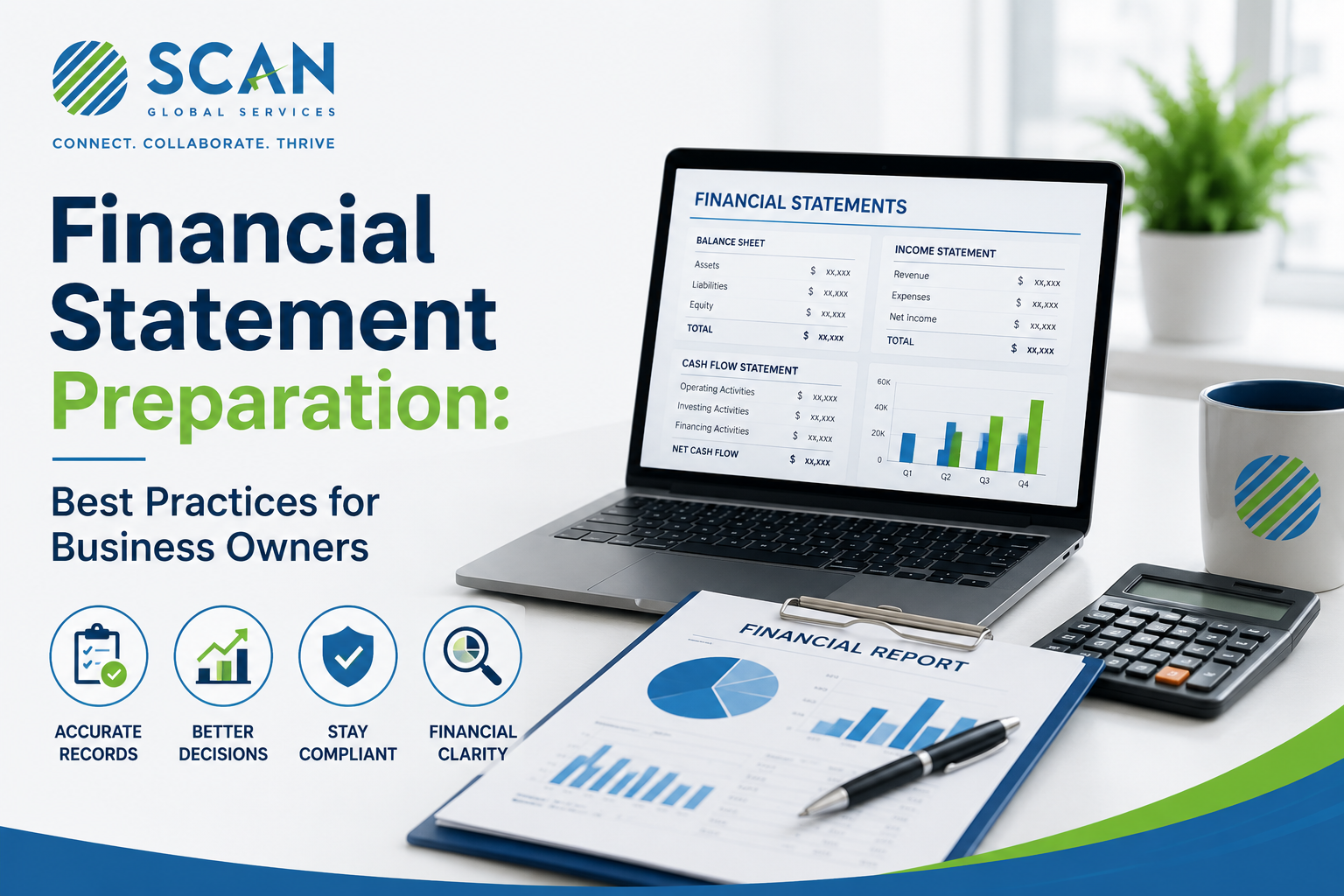
Financial Statement Preparation: Best Practices for Business Owners
The success and continuing viability of businesses of all types depend upon financial statements. Each and every business relies upon its financial statements to make informed decisions, secure financing, evaluate financial risks, and facilitate long-term growth. For instance, while some managers devote a large portion of their time to increasing revenue (through sales, acquiring customers, and improving operational efficiency), it is their ability to accurately interpret and use their company’s financial data that will most dramatically impact the ability to achieve their business goals.
Today, financial statement preparation services in usa are viewed as much more than just a report to be filed with the IRS or state agencies for tax purposes. Instead, they are now viewed as an important tool for business owners who utilize them to make financial decisions about their company.
The demand for the services of Certified Public Accountants to prepare and issue reliable financial statements has continued to rise as the business environment becomes increasingly uncertain due to ever-changing economic conditions, increasing regulatory compliance and financial complexity, and greater competition among businesses operating in the USA. As a result, business owners are beginning to appreciate that their company’s financial reporting will enable them to enhance operational control within their organization and ultimately give them greater confidence in making strategic decisions.
By understanding best practices related to the preparation of financial statements, businesses can enhance their financial visibility, improve the accuracy of their financial statement reporting, and create a stronger base on which to grow their operations.
Why Financial Statement Preparation Services in USA Matter
Financial statements provide a structured view of a company’s financial activities and overall business performance. These reports help business owners, investors, lenders, stakeholders, and management teams evaluate financial conditions and make important business decisions.
Properly prepared financial statements support several critical functions including:
- Measuring financial performance
- Monitoring profitability
- Evaluating cash flow health
- Supporting tax and compliance requirements
- Preparing for audits
- Assisting with funding opportunities
- Strengthening investor confidence
- Supporting business planning and forecasting
Without reliable financial statements, businesses may struggle to understand their financial position accurately, which can lead to poor decisions, compliance challenges, and operational inefficiencies.
Businesses that maintain strong financial reporting practices often have greater visibility into both opportunities and potential risks.
Understanding the Core Financial Statements
Before discussing best practices, business owners should understand the primary financial statements that organizations commonly prepare and analyze.
Income Statement
The income statement, sometimes referred to as the profit and loss statement, summarizes revenues, expenses, and profits during a specific period.
This statement helps businesses evaluate:
- Revenue generation
- Operating expenses
- Gross profit margins
- Net profitability
- Financial performance trends
Income statements help leadership teams understand whether operations are generating sustainable profits over time.
Balance Sheet
The balance sheet provides a snapshot of a company’s financial position at a particular point in time by outlining assets, liabilities, and equity.
This report helps businesses assess:
- Available resources
- Debt obligations
- Financial stability
- Capital structure
- Overall business health
Balance sheets often provide valuable information regarding a company’s long-term financial strength.
Cash Flow Statement
The cash flow statement tracks the movement of cash entering and leaving the business.
It generally includes:
- Operating activities
- Investing activities
- Financing activities
Cash flow statements help organizations understand liquidity and determine whether sufficient cash exists to support ongoing operations and future growth initiatives.
Maintain Accurate Bookkeeping Throughout the Year
A cash flow statement is a benchmark to check the cash flow position of an organization and to assess the liquidity status of the organization to determine whether it has adequate cash available for operations and future growth.
Accurate Recordkeeping Throughout the Year
It is advisable to have proper recordkeeping in place throughout the year while preparing financial statements.
The reason being most organizations approach recordkeeping merely as a year-end activity and therefore, there is a gap between reconciliations, missing transactions, inconsistency and incompleteness in records resulting ultimately in errors in the financial statements.
Maintaining organized bookkeeping processes helps ensure:
- Accurate transaction recording
- Timely reconciliations
- Proper expense tracking
- Reliable financial reporting
- Reduced reporting errors
Businesses that maintain current records often experience smoother month-end and year-end closing processes while reducing stress during audits and tax preparation periods.
Consistent bookkeeping also improves overall financial visibility and supports better operational decision-making.
Implement Standardized Reporting Processes
Financial reporting consistency is essential for maintaining accuracy and reliability across reporting periods.
Businesses should establish standardized procedures for:
- Recording transactions
- Categorizing expenses
- Reconciling accounts
- Reviewing financial information
- Preparing reports
- Maintaining documentation
Without standardized processes, organizations may experience inconsistencies that make financial analysis difficult and reduce confidence in reported data.
Standardized procedures also improve collaboration among accounting teams and create stronger internal controls.
Businesses with structured reporting processes often identify discrepancies more quickly and maintain greater financial transparency.
Conduct Regular Account Reconciliations
Account reconciliations are a critical component of accurate financial statement preparation.
Reconciliation involves comparing financial records against supporting documents such as bank statements, credit card transactions, payroll reports, and vendor invoices to ensure that recorded information matches actual activity.
Regular reconciliations help businesses:
- Identify discrepancies early
- Prevent reporting errors
- Detect fraud risks
- Improve financial accuracy
- Maintain complete records
Waiting until year-end to reconcile accounts can create significant challenges and increase the likelihood of mistakes.
Monthly reconciliations allow businesses to maintain cleaner records and avoid unexpected reporting issues.
Review Financial Statements Before Finalization
Preparing financial statements should not be treated as a simple administrative task. Business owners and accounting teams should carefully review financial reports before they are finalized and distributed.
Review processes should include evaluating:
- Revenue trends
- Expense fluctuations
- Account balances
- Unusual transactions
- Profitability patterns
- Cash flow activity
Unexpected changes may indicate recording errors, missing entries, or operational issues that require additional investigation.
A detailed review process helps improve accuracy and ensures that financial statements present a realistic picture of business performance.
Organizations that regularly review financial data often gain valuable operational insights that extend beyond compliance requirements.
Leverage Technology for Better Financial Reporting
Modern financial reporting increasingly depends on cloud-based systems, automation tools, and integrated accounting platforms.
Technology allows businesses to improve efficiency by reducing manual processes and increasing reporting accuracy.
Accounting technologies commonly support:
- Automated transaction categorization
- Real-time financial reporting
- Expense management
- Reconciliation workflows
- Financial dashboards
- Data analysis
Businesses that utilize modern financial systems often experience faster reporting cycles and greater visibility into financial performance.
Technology also reduces the administrative burden associated with maintaining large volumes of financial information.
Work with Experienced Financial Professionals
Although many business owners attempt to manage financial reporting internally, increasing business complexity often creates situations where professional support becomes valuable.
Experienced accounting professionals help organizations:
- Maintain compliance requirements
- Improve reporting accuracy
- Establish stronger controls
- Prepare reliable financial statements
- Support strategic financial planning
The need for professional financial advisory services increases when businesses grow, have multiple entities or operate in several states/industries.
Having a trustworthy and dependable means of preparing financial statements is crucial for reducing errors in your business and increasing the confidence that you have in the process of preparing accurate financial statements.
How Financial Statement Preparation Supports Business Growth
Financial statements provide much more than historical reporting information. They also serve as a foundation for future planning and strategic decision-making.
Accurate financial reporting helps businesses:
- Secure funding opportunities
- Improve budgeting processes
- Support expansion initiatives
- Monitor profitability
- Evaluate performance trends
- Manage financial risks
Investors, lenders, and stakeholders frequently rely on financial statements when evaluating business performance and growth potential.
Organizations with strong financial reporting practices often have an easier time attracting investment and supporting long-term business objectives.
How scanglobalservices Supports Businesses
Scan Global Services provides integrated services for accounting, bookkeeping, payroll management and audit assistance; as well as Financial Controller support and preparation of Financial Statements aimed at helping businesses to enhance their reporting accuracy and operational efficiency.
Scan Global Services, with 70+ years of experience and a contemporary global delivery model, gives organizations customized financial solutions, knowledgeable accounting professionals, high standards of confidentiality and scalable support.
This approach will assist businesses in improving their financial visibility, increasing their reporting process efficiencies, and establishing trustworthy financial foundations that aid in sustaining growth.
Proficient financial support may be an essential contributor to long-term success for companies looking for better financial control and improved operational clarity.
Need help with financial reporting? Talk to Our Experts
Final Thoughts
There has been a growing need to accurately prepare and present Financial Statements over the past several years because of the increasing complexity of financial reporting and the expectations for transparency and accountability.
Accurate Financial Statements enable Business Owners to assess performance, make informed decisions, comply with regulations, and to have the confidence to pursue new business opportunities
Organizations that follow best practices (accurate bookkeeping, standardized processes, routine reconciliations, technology-assisted processes, and using qualified professionals) will be able to develop higher quality Financial Reporting Standards which will help to prepare them for the future.
As we head into 2026 and beyond, sustainable business management will depend on continued strong practices in preparing financial statements.
Frequently Asked Questions
What are financial statement preparation services?
A financial statement writing service provides an accountant with the ability to collect, examine, and prepare financial reports for an organization, including income statements, balance sheets, and cash flow statements that accurately reflect the organization’s financial situation.
Why are financial statements important for businesses?
Financial statements play a key role in helping organizations monitor their performance, evaluate profit, maintain compliance with various laws and regulations, identify funding opportunities, and make informed decisions based on their strategic plans.
How often should businesses prepare financial statements?
Organizations generally prepare financial statements either monthly, quarterly or annually depending on their reporting needs, the complexity of the organization’s operations, and the requirements of the stakeholders.
What causes errors in financial statements?
Common causes of financial reporting errors include incomplete bookkeeping, delayed reconciliations, incorrect transaction classifications, missing documentation, and inconsistent reporting procedures.
Can outsourced financial statement preparation improve reporting accuracy?
Outsourcing Financial Statement Preparation & Support Services will give you access to professionals who have experience maintaining accurate records, helping to ensure compliance with all related laws and regulations, and helping to improve the overall financial reporting process.